Choosing Scientific Laboratory Equipment is not a simple purchasing task. It is a decision about accuracy, safety, workflow, and future research needs. A centrifuge may look impressive, yet its rotor capacity, speed control, noise level, and maintenance requirements matter more than appearance. The same applies to balances, microscopes, incubators, and analytical instruments.
Lord Kelvin, a pioneer of measurement science, wrote, “When you can measure what you are speaking about, and express it in numbers, you know something about it.” His principle remains useful when comparing laboratory equipment. Buyers should examine measurement range, repeatability, calibration records, software compatibility, and service support. These details reveal whether equipment can perform reliably during real experiments, not only during a product demonstration.
Experience also changes the decision. A busy laboratory may need quick cleaning, intuitive controls, and accessible replacement parts. A teaching laboratory may value durability over advanced automation. Environmental conditions matter too. Temperature, humidity, vibration, and electrical stability can quietly affect results. Small details become expensive problems.
A perfect choice is unlikely.
Some specifications may be misunderstood. Staff feedback should therefore shape the final selection. Ask who will operate the equipment, how often it will be used, and what failure would cost. Independent testing, certification documents, and transparent warranties strengthen confidence. Reliable Scientific Laboratory Equipment should support reproducible work while fitting the laboratory’s budget, space, and responsibilities. The best choice is not always the most advanced model. It is the one that performs consistently when people, samples, and schedules are imperfect.
How to Choose Scientific Laboratory Equipment?
Define Laboratory Goals and Required Measurements
Equipment selection should begin with the question, “What must this experiment measure?” Define the sample type, expected range, resolution, accuracy, throughput, and acceptable uncertainty. A balance for milligram-level work needs different specifications from one used for kilogram-scale preparation. Record temperature, humidity, vibration, and available power. These details often expose hidden costs.
Nature’s 2016 survey of 1,576 researchers found that more than 70% had failed to reproduce another scientist’s experiments. Poorly defined measurements can contribute to this problem. Write a measurement plan before requesting quotations. Include calibration intervals, reference materials, data formats, and operator training. The NIST Technical Note 1297 also emphasizes reporting measurement uncertainty, not only the displayed value. A result of 10.0 is incomplete without its uncertainty.
Think about the entire workflow. A fast instrument may create bottlenecks during preparation, cleaning, or data review. The World Health Organization’s Laboratory Biosafety Manual, fourth edition, recommends risk assessment before laboratory activities begin. Apply that principle to equipment planning. Check containment needs, maintenance access, waste handling, and failure response. My selection sheets are rarely perfect; I sometimes overestimate future demand. A pilot test can reveal that weakness. Measure real samples, not only vendor-provided standards. Keep raw data and service records. Reliability grows from evidence, although the first equipment list may still need revision.
Set performance, accuracy, and capacity requirements before comparing equipment. Performance means more than speed. Define temperature stability, measurement range, recovery time, and daily operating hours. The WHO Laboratory Quality Management System handbook recommends matching equipment to its intended use, workflow, and maintenance capability. That principle prevents impressive specifications from becoming expensive clutter.
Accuracy must reflect the method, not the brochure. NIST Technical Note 1297 explains that measurement uncertainty includes both statistical and systematic components. Set an acceptable uncertainty limit before purchase. Then check calibration intervals, traceability, and environmental tolerance. ISO/IEC 17025:2017 also emphasizes metrological traceability. In practical planning, I have seen teams choose ultra-sensitive instruments without controlling vibration or room temperature. The result was technically advanced, but unreliable.
Capacity should match real demand, with a modest growth allowance. UNESCO’s 2023 Institute for Statistics fact sheet reports global R&D spending reached 1.93% of GDP in 2021. More research activity can increase sample volume, but forecasts remain imperfect. Avoid buying for an imagined workload. Measure weekly samples, peak batches, staffing, and available bench space. Leave room for cleaning and service access.
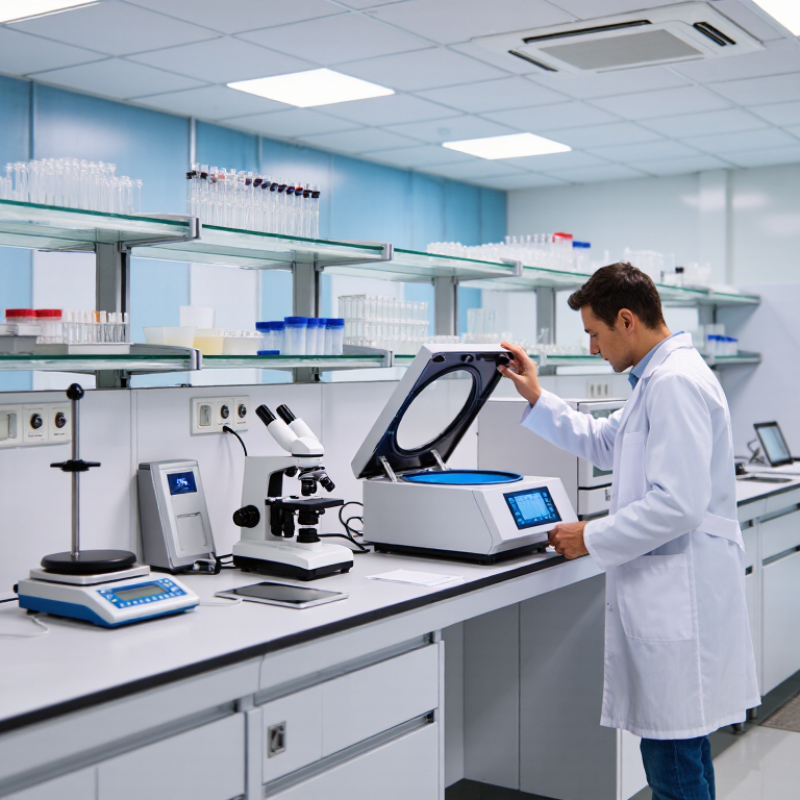
Choosing scientific laboratory equipment starts with comparing its intended use, not its appearance. A benchtop centrifuge may suit routine sample separation, while an ultracentrifuge serves specialized research. Confirm speed, capacity, temperature control, and noise levels. These features affect daily workflow and sample quality. A clear digital display helps, but reliable calibration matters more. I have seen attractive instruments create delays because their settings were difficult to verify.
Compatibility deserves equal attention. Check whether tubes, plates, probes, software, and power requirements match your existing setup. A microscope may require specific objectives and illumination systems. Analytical balances need stable benches and suitable environmental control. Confirm connection standards before purchase. One overlooked port can become an expensive limitation. Also review cleaning procedures, replacement parts, warranty terms, and service availability. Specifications can look perfect on paper, yet practical access may be poor.
Tips: Create a comparison table before ordering. Record measurable features, operating costs, maintenance needs, and training requirements. Ask technical staff to test representative samples when possible. Leave room for future methods, but avoid paying for functions no one will use. Document the final compatibility checks. Small notes prevent large mistakes. Reflect on the decision after a trial period; actual user feedback may reveal weaknesses that product documentation misses.
| Equipment Type | Primary Application | Typical Performance Range | Important Features to Compare | Sample and Consumable Compatibility | Utilities and Installation Requirements | Key Selection Considerations |
|---|---|---|---|---|---|---|
| Analytical Balance | Measuring the mass of powders, liquids, standards, and prepared samples with high precision. | Readability commonly ranges from 0.1 mg to 1 mg; maximum capacity is often approximately 100–300 g. | Draft shield, internal or external calibration, repeatability, linearity, stabilization time, overload protection, and data export. | Compatible with weighing boats, paper, crucibles, vials, and other containers that fit inside the weighing chamber. | Stable, vibration-free bench; low air movement; level surface; controlled temperature and humidity are recommended. | Choose readability and capacity according to the smallest required sample mass. Avoid placing the balance near doors, vents, or centrifuges. |
| Benchtop Centrifuge | Separating cells, particles, precipitates, phases, or biological components by centrifugal force. | Typical maximum speed ranges from about 4,000 to 18,000 rpm; relative centrifugal force depends on rotor radius and speed. | Maximum RCF, rotor type, rotor capacity, acceleration and braking profiles, imbalance detection, temperature control, and safety interlock. | Must match tube format, tube volume, rotor adapters, and material resistance. Common formats include microtubes, conical tubes, and multiwell plates. | Level bench, adequate ventilation, grounded electrical outlet, and sufficient clearance for lid operation and maintenance. | Compare RCF rather than rpm alone. Confirm that the rotor supports the required tube size and chemical or biological sample type. |
| pH Meter | Determining acidity or alkalinity in aqueous solutions, buffers, culture media, and process samples. | Common measurement range is pH 0–14 with resolution of 0.01 or 0.001 pH units; accuracy is often approximately ±0.01 pH units under suitable conditions. | Automatic temperature compensation, calibration points, electrode condition monitoring, data logging, and replaceable probe options. | Electrode selection should match sample viscosity, ionic strength, temperature, solids content, and chemical composition. | Stable bench, clean water for rinsing, calibration buffers, proper storage solution, and an appropriate electrical or battery supply. | Use fresh, certified buffer solutions. Select a specialized electrode for samples containing proteins, solvents, low conductivity, or suspended solids. |
| UV-Visible Spectrophotometer | Quantifying absorbance or transmittance for concentration measurements and reaction monitoring. | Typical wavelength coverage is approximately 190–1,100 nm; spectral bandwidth may range from about 0.5–5 nm. | Wavelength accuracy, photometric range, stray light, scan speed, lamp type, cuvette holder, software, and calibration functions. | Requires cuvettes compatible with the wavelength and solvent. Quartz is required for many ultraviolet measurements; glass or plastic may be suitable in parts of the visible range. | Stable temperature, clean optical environment, grounded power, and space for sample handling and computer connectivity. | Confirm wavelength range, optical path length, solvent compatibility, and whether the instrument supports single-beam or reference-beam workflows required by the method. |
| High-Performance Liquid Chromatography System | Separating, identifying, and quantifying compounds in pharmaceutical, environmental, food, and research samples. | Typical analytical flow rates are approximately 0.1–10 mL/min; common pressure limits range from about 400 to 1,000 bar depending on system design. | Pump precision, injector volume, detector type, column temperature control, solvent degassing, gradient capability, pressure monitoring, and software audit trails. | All wetted materials, tubing, seals, filters, columns, and vials must be compatible with the mobile phase, analytes, pH, pressure, and temperature. | Requires stable power, solvent storage, waste containment, ventilation as appropriate, clean gas supply for some detectors, and adequate bench space. | Start with the analytical method. Verify column dimensions, detector requirements, solvent compatibility, pressure range, and regulatory data-handling needs. |
| PCR Thermal Cycler | Amplifying specific DNA or complementary DNA sequences through controlled temperature cycling. | Common block formats support 24, 48, 96, or 384 reaction positions; temperature ranges commonly cover approximately 4–100 °C. | Temperature uniformity, ramp rate, heated lid, gradient function, block format, program capacity, and compatibility with reaction vessels. | Must match tube, strip, or plate format and reaction volume. Consumables should tolerate repeated heating and maintain a reliable seal. | Clean, low-dust bench; stable power; controlled ambient temperature; separate areas and workflows are recommended for pre- and post-amplification work. | Choose block format and gradient capability based on throughput and assay development needs. Prevent contamination through dedicated workflow zones. |
| Class II Biological Safety Cabinet | Protecting personnel, samples, and the surrounding laboratory during work with potentially hazardous biological materials. | Typical inward airflow is approximately 0.38–0.51 m/s, depending on cabinet design and applicable safety standards. | HEPA filtration, airflow monitoring, sash alarm, decontamination access, work-surface layout, noise level, and certification requirements. | Suitable for many microbiological procedures, but not a substitute for a chemical fume hood when handling volatile toxic chemicals or radionuclides. | Requires adequate room clearance, electrical power, airflow certification, and careful placement away from doors, vents, and high-traffic areas. | Select the cabinet class and size according to risk assessment, workflow, equipment placed inside, and applicable biosafety requirements. |
| Laboratory Autoclave | Steam sterilization of suitable laboratory media, glassware, instruments, and biohazard waste. | Common sterilization cycles operate near 121 °C at approximately 103 kPa gauge pressure or near 134 °C at higher pressure, depending on the cycle. | Chamber volume, temperature and pressure monitoring, pre-vacuum function, drying cycle, liquid-cycle control, door interlock, and documentation. | Loads must be compatible with saturated steam, heat, pressure, and moisture. Sealed containers and volatile chemicals require special handling or are unsuitable. | Requires suitable electrical power, heat-resistant flooring, ventilation, water or drainage depending on design, and clearance for loading and servicing. | Choose chamber size from actual load patterns. Validate cycles for liquids, porous materials, instruments, and waste rather than relying on one universal program. |
| Inverted or Upright Microscope | Viewing cells, tissues, microorganisms, materials, or prepared slides at magnifications above the unaided eye. | Common objective magnifications include 4×, 10×, 20×, 40×, and 100× oil immersion; total magnification depends on the eyepiece. | Optical resolution, illumination type, contrast methods, objective correction, camera port, mechanical stage, focus mechanism, and ergonomic design. | Sample holders and objectives must match slide size, culture vessels, coverslip thickness, immersion medium, and sample geometry. | Stable, low-vibration bench; controlled lighting; clean optics; and adequate room for camera, monitor, or imaging accessories. | Prioritize numerical aperture and contrast method over magnification alone. Choose an inverted configuration for specimens in culture vessels or multiwell plates. |
| Laboratory Fume Hood | Containing and exhausting airborne chemical vapors, gases, aerosols, and odors during chemical procedures. | Face velocity is commonly designed around 0.4–0.6 m/s, subject to local standards, hood type, and risk assessment. | Airflow monitoring, sash design, interior material, work-surface depth, alarm system, exhaust configuration, and service access. | Interior and work-surface materials must resist the chemicals, temperatures, and processes used. It is not designed for biological containment. | Requires dedicated exhaust ducting or an approved filtered design, make-up air, electrical service, and clearance from competing air currents. | Match the hood to chemical hazards and process scale. Confirm exhaust requirements, duct compatibility, energy use, and local installation standards. |
Safety and compliance should guide every purchase. The UK Health and Safety Executive reported 1.7 million workers with work-related illness in 2023/24. Laboratory risks may be smaller, but poor design still creates daily exposure. Check guarding, interlocks, spill control, ventilation, alarms, and emergency access. Confirm that the equipment supports applicable national rules and quality systems. ISO/IEC 17025 emphasizes calibration, measurement traceability, and controlled records. Ask for test certificates, validation procedures, and software audit trails before approval. A polished brochure is not evidence.
Maintenance and support determine whether equipment remains reliable after installation. The U.S. Department of Energy’s Labs21 guidance notes that laboratories can use up to five times more energy per square foot than offices. Energy demand matters, especially for continuously cooled instruments and ventilation systems. Compare preventive-maintenance intervals, filter costs, spare-part availability, technician response times, and training options. Request a realistic five-year ownership estimate. Low purchase cost can mislead. A perfect specification can still fail during a weekend fault.
Choosing scientific laboratory equipment starts with a complete cost plan, not a shopping list. Include purchase price, delivery, utilities, calibration, service, training, and disposal. The U.S. Department of Energy’s Labs21 guidance reports that laboratories can use five to ten times more energy per square foot than offices. Energy demand deserves attention.
Set aside funds for installation changes. A large analyzer may require reinforced flooring, dedicated circuits, stable temperature, exhaust, or purified water. Ask contractors for utility drawings before ordering. A cheaper instrument can become expensive after building modifications. I have seen project spreadsheets overlook door widths and freight access. That mistake is small, but disruptive.
Validation should follow a documented, risk-based plan. Installation qualification confirms correct setup, operational qualification checks performance, and performance qualification proves routine use. ISO/IEC 17025 principles also emphasize competent personnel, traceability, and reliable records. Keep acceptance criteria measurable, such as temperature stability, detection limits, or alarm response time. Leave spare capacity in electrical panels, ventilation, network ports, and bench space. The National Institutes of Health Design Requirements Manual recommends planning adaptable laboratory infrastructure for changing research needs. Review assumptions annually. Some will be wrong. Future expansion may require another instrument, more samples, or new data controls, so flexible layouts and modular utilities can protect the next budget.