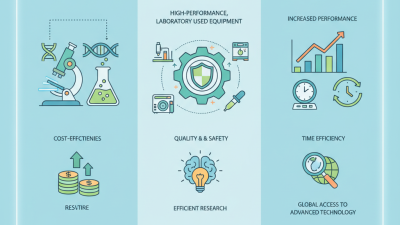
Why Choose Reliable Research Lab Equipment Suppliers?
Choosing reliable Research Lab Equipment suppliers is not a simple purchasing decision. It directly influences data quality, laboratory safety, and research credibility. A faulty incubator may fluctuate by two degrees overnight. An unstable balance can distort measurements by a few milligrams. Small errors can become expensive conclusions.
Dr. William Thomson, widely known as Lord Kelvin and a pioneer in scientific measurement, stated, “If you cannot measure it, you cannot improve it.” His principle remains highly relevant today. Dependable suppliers provide more than instruments. They offer calibration records, transparent specifications, technical training, and responsive maintenance. These details help researchers control variables and repeat experiments with greater confidence.
A trustworthy supplier should explain limitations clearly. Ask about temperature uniformity, detection limits, software compatibility, spare parts, and service response times. Request evidence, not impressive promises. Look for documented quality procedures and experienced technicians. A reliable company should also understand your workflow, from sample preparation to final data review.
No supplier is perfect. That deserves honest reflection. Delivery delays, confusing interfaces, or incomplete documentation can still occur. The real difference appears in how the supplier responds. Do they investigate the problem? Do they replace defective parts promptly? Do they record corrective actions?
Researchers should compare total ownership costs, not only purchase prices. A cheaper centrifuge may create repeated downtime and damaged samples. A well-supported system may cost more initially, yet protect years of work. Choosing reliable suppliers strengthens laboratory performance, supports ethical research, and helps teams produce results others can trust. That is the practical value of dependable equipment.
What Defines a Reliable Research Lab Equipment Supplier?
Reliable research lab equipment suppliers are defined by evidence, not polished promises. Their reliability begins with accurate specifications, clear delivery terms, and documented quality checks. A trustworthy supplier provides calibration records, serial number tracking, and maintenance guidance. Each certificate should identify the testing method and date. Not vague assurances. They also explain equipment limits, including temperature range, measurement tolerance, and expected service life.
Practical support matters just as much. In daily laboratory work, a delayed replacement part can interrupt an experiment for several days. Reliable suppliers therefore offer installation help, user training, troubleshooting, and accessible technical staff. Their response times should be written clearly. They should also maintain essential spare parts and provide safe cleaning instructions. Independent test reports, qualified engineers, and references from comparable laboratories strengthen their authority.
No supplier is flawless. A careful evaluation should include weaknesses, not only strengths. For example, a supplier may provide excellent equipment but slow overseas support. That detail can affect research schedules. I would compare warranty conditions, repair procedures, software updates, and total ownership costs before ordering. A small demonstration can reveal practical problems, such as noisy operation or confusing controls. Honest suppliers welcome these questions and admit where their equipment may not fit a laboratory’s needs.
How Supplier Reliability Affects Laboratory Operations
Reliable research lab equipment suppliers influence far more than purchasing speed. They shape calibration records, experiment schedules, and the quality of evidence produced.
McKinsey’s 2022 Global Supply Chain Leader Survey reported that 73% of respondents experienced supply chain problems during the previous year. In a laboratory, one delayed sensor can leave samples waiting beside a powered-down instrument. That is expensive. It is also scientifically risky.
A dependable supplier provides traceable specifications, realistic lead times, service documentation, and responsive technical support. These details protect daily operations when a temperature alarm sounds at 6:00 a.m. or a centrifuge shows an unfamiliar error code.
The World Health Organization’s Laboratory Quality Management System guidance identifies equipment management, maintenance, and records as core quality activities. Nature’s 2016 survey of 1,576 researchers found that more than 70% had failed to reproduce another scientist’s experiments, while over half had failed to reproduce their own.
Equipment is not the only cause, but unstable performance can quietly add uncertainty. A supplier’s certificate should therefore be checked, not merely filed.
Reliability is helpful, but not magic.
Laboratories still need trained staff, preventive maintenance, and independent verification. That uncomfortable part is often ignored.
The Role of Technical Support, Maintenance, and Training
Why Choose Reliable Research Lab Equipment Suppliers?
The Role of Technical Support, Maintenance, and Training
Reliable suppliers provide more than instruments and delivery dates. They provide technical support when results suddenly drift, alarms appear, or calibration fails before a critical run. Support matters. A trained specialist can inspect installation conditions, review error logs, and guide safe troubleshooting without guessing.
Maintenance also protects data quality. The World Health Organization’s Laboratory Quality Management System handbook identifies equipment management, calibration, and documented maintenance as core quality activities. Its guidance supports a practical point: neglected equipment can undermine accurate testing, even when procedures look correct. The WHO and UNICEF Joint Monitoring Programme reported in 2023 that roughly one in five healthcare facilities lacked basic water services. This makes installation checks, cleaning plans, and environmental training especially important in resource-limited laboratories.
Training should continue after commissioning. Operators need practice with startup checks, software updates, preventive maintenance, and emergency shutdowns. The International Organization for Standardization’s ISO 15189:2022 standard also emphasizes staff competence and controlled equipment processes. A dependable supplier can document each session and assess whether technicians can perform tasks independently. That evidence supports audits and reduces avoidable downtime.
A perfect maintenance plan is unrealistic. Even experienced teams miss details. Suppliers should therefore offer responsive help, clear service records, spare-part planning, and refresher training. Lab managers can ask for response-time targets and escalation procedures before purchase. The best partnership feels visible during routine work, not only during a breakdown.
How to Select the Right Supplier for Long-Term Research Needs
Selecting a research equipment supplier should begin with your workflow, not a glossy catalog. Map each critical step: sample preparation, measurement, cleaning, calibration, and data export. Ask for documented accuracy, service intervals, spare-part availability, and response times. A low purchase price can become expensive when a freezer fails on Friday night.
Reproducibility makes supplier quality a scientific issue. Nature’s 2016 survey of 1,576 researchers reported that more than 70% had struggled to reproduce another scientist’s work. Equipment is not the only cause, but unstable temperature control, unclear software settings, and weak calibration records can quietly damage results. Choose suppliers that provide traceable calibration certificates, validation support, user training, and maintenance history. ISO/IEC 17025-accredited calibration services offer stronger evidence than informal inspection notes.
Look beyond the first installation. The WHO Laboratory Quality Management System handbook emphasizes documented processes, competence, equipment control, and corrective action. Request sample service reports before signing. Check whether technicians can reach your facility, whether loan equipment is available, and how firmware updates affect old systems. Speak with current users, not only sales representatives. Their answers may be less polished, but more useful. I would also run a small pilot when possible. It costs time. Still, skipping that step can expose hidden workflow problems after a major purchase. A reliable supplier should welcome careful questions, even awkward ones.
Why Choose Reliable Research Lab Equipment Suppliers?
A structured supplier evaluation helps research teams balance technical performance, service continuity, compliance, and total ownership cost when selecting a long-term equipment partner.
The chart presents a 100-point procurement evaluation model. Product quality and technical compatibility receive the highest weighting because they directly affect measurement accuracy, experimental repeatability, and laboratory workflow continuity. After-sales service, calibration support, compliance documentation, delivery reliability, and total cost are also essential for reducing long-term operational risk.