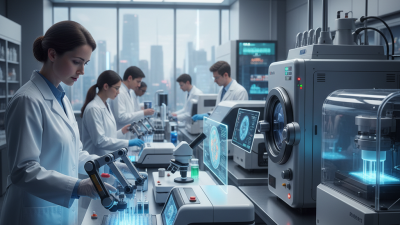
Top Analytical Equipment for Precision Testing in Various Industries?
In today's industrial landscape, the demand for precision testing is paramount. Accurate results drive product quality and safety across sectors like pharmaceuticals, food and beverage, and environmental monitoring. Analytical Equipment plays a crucial role in achieving these standards. The global analytical equipment market was valued at approximately $40 billion in 2022 and is expected to grow steadily, reaching around $57 billion by 2030.
Different industries utilize various analytical instruments to ensure compliance with stringent regulations. For instance, the pharmaceutical sector relies heavily on high-performance liquid chromatography (HPLC) to analyze compounds with precision. Yet, the challenge lies in the calibration and maintenance of these instruments. Inaccurate readings can lead to significant financial losses and safety hazards.
Reflecting on the changing dynamics, we must acknowledge the technological advancements in Analytical Equipment. Emerging innovations are indeed increasing efficiency, but they also require continuous updating of skills. While automation and AI offer promising enhancements, they might not completely eliminate human error. Consequently, industries should prioritize training and adapt to evolving technologies to maintain the highest accuracy in testing.
Overview of Analytical Equipment in Precision Testing
In various industries, precision testing hinges on advanced analytical equipment. This equipment plays a crucial role in ensuring product quality and compliance. For example, in pharmaceuticals, accurate measurements can mean the difference between safe and unsafe products. Sophisticated instruments are vital for analyzing chemical compositions and ensuring they meet regulatory standards.
Tip: Always calibrate your equipment regularly. This simple step can significantly enhance the accuracy of your tests.
Analytical devices such as spectrometers and chromatographs are essential tools. They provide detailed insights into the properties of materials. In food production, testing for contaminants is another key application. Equipment must be reliable to prevent health risks. However, not all tests yield perfect results. Variability can occur due to sample quality or instrument malfunction.
Tip: Documentation of testing procedures can uncover patterns that improve reliability.
Operators need to understand the limitations of each tool. Users should remain aware that factors like temperature can impact results. Regular training on equipment use is important. Some tests might need more than one approach to ensure accuracy. Precision testing is not just about having the right tools; it’s also about thoughtful execution.
Top Analytical Equipment for Precision Testing
Key Applications of Analytical Equipment Across Different Industries
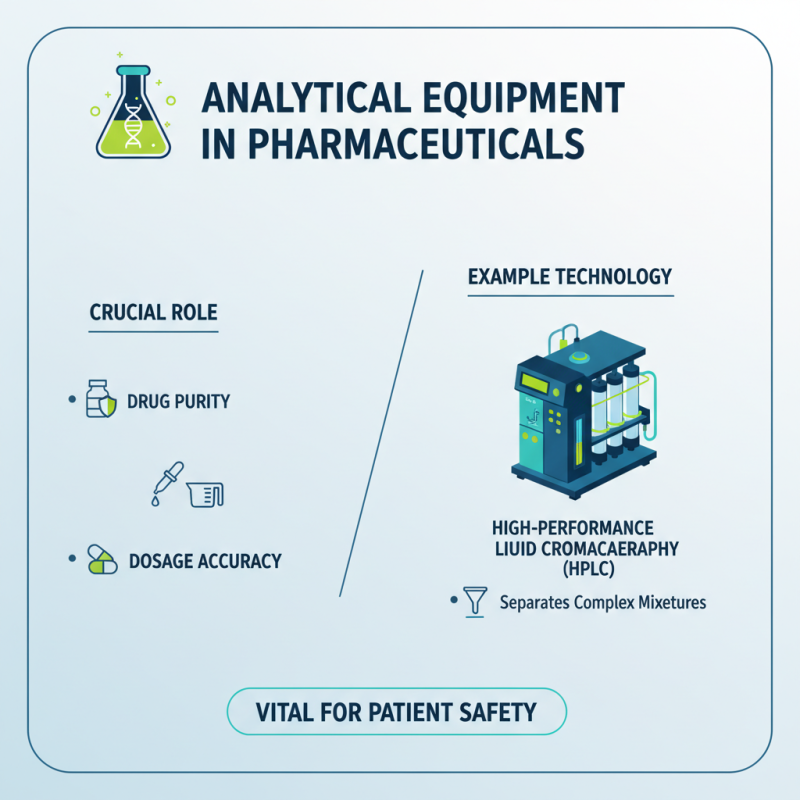
Analytical equipment plays a crucial role in many industries. In pharmaceuticals, these tools ensure drug purity and dosage accuracy. For example, high-performance liquid chromatography can separate complex mixtures efficiently. This level of precision is vital for patient safety.
In the food industry, analytical equipment tests for contaminants and nutritional content. Advanced techniques detect pesticides and bacteria. Ensuring food safety is a persistent challenge. Sometimes, results can be inconsistent, making regular calibration essential. Equipment must adapt to various sample types.
Environmental testing is another essential application. Analysts use equipment to measure pollutant levels in air and water. This data helps track contamination sources. While technology improves testing capabilities, human error remains a factor. Proper training is essential but can sometimes be overlooked.
Types of Analytical Instruments Used for Precision Testing
In various industries, analytical instruments play a vital role in precision testing. These devices help ensure quality control, safety, and compliance with industry standards. Common types of analytical equipment include spectrophotometers, chromatographs, and mass spectrometers. Each of these instruments serves a unique purpose in evaluating samples.
Spectrophotometers measure light absorption to determine concentration levels. They are widely used in chemical analysis and biology. Chromatographs separate mixtures into individual components. This process is essential in pharmaceuticals and environmental testing. Mass spectrometers, on the other hand, provide detailed molecular information. They can identify substances present in very small amounts.
Despite their accuracy, analytical instruments have limitations. For example, calibration errors can lead to incorrect results. Regular maintenance is necessary but often neglected. Misinterpretation of data can occur when operators lack training. Some instruments require sophisticated setups, which can be daunting for new users. In the quest for precision, understanding these challenges is crucial.
Top Analytical Equipment for Precision Testing in Various Industries
| Type of Instrument |
Industry |
Main Application |
Precision Level |
| Mass Spectrometer |
Pharmaceutical |
Quantitative Analysis |
ppm level |
| Gas Chromatograph |
Environmental |
Air Quality Testing |
ppb level |
| High-Performance Liquid Chromatograph (HPLC) |
Food & Beverage |
Nutritional Analysis |
µg level |
| Fourier Transform Infrared Spectrometer (FTIR) |
Chemical |
Material Identification |
High Resolution |
| pH Meter |
Water Quality |
pH Level Testing |
±0.01 pH |
Factors Influencing the Selection of Analytical Equipment
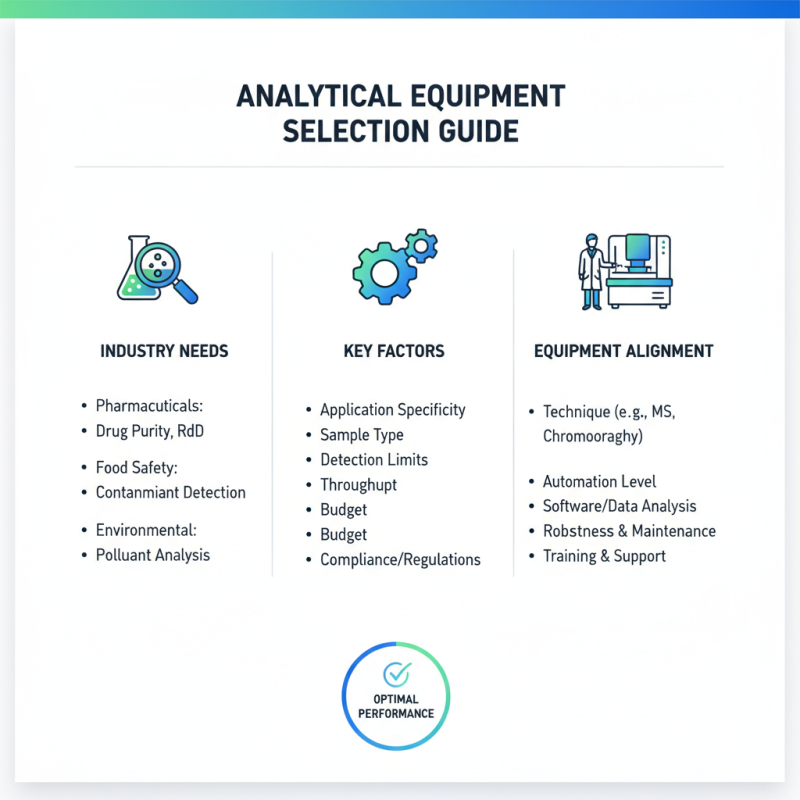
When selecting analytical equipment, several factors play a critical role. Understanding the specific needs of an industry is paramount. Different sectors, such as pharmaceuticals or food safety, require unique testing methods. Hence, the equipment must align with the particular parameters of the relevant field.
Budget constraints are another significant consideration. High-precision equipment can be costly. However, investing in reliable tools often leads to better quality data. Sometimes, organizations may compromise on features to meet financial limitations. This can affect the overall effectiveness of testing protocols.
Ease of use is essential too. Complex systems might require extensive training. Such requirements can delay results or lead to errors. Choosing equipment that balances complexity with usability can save time. However, many users tend to overlook this aspect in pursuit of advanced features. Ultimately, a comprehensive evaluation of these factors can significantly enhance the selection process.
Future Trends in Analytical Technology for Enhanced Precision Testing
Future trends in analytical technology are driving precision testing in various industries.
Advancements like artificial intelligence and machine learning
play a crucial role. These technologies allow for better data analysis and improved accuracy.
Instruments are becoming more automated, reducing human error. With increased efficiency,
industries can save time and costs.
Tips: Always calibrate your equipment regularly. Regular checks ensure data integrity and reliability.
Emerging techniques, such as microfluidics, are gaining traction. They enable precise measurements with minimal sample volume.
This is particularly useful in the pharmaceutical and biotechnology sectors.
However, not all labs have adopted these technologies. Resistance to change can hinder progress and efficiency.
Tips: Stay informed about new technologies. Attending workshops or webinars can provide valuable insights.
As industries look to the future, the demand for precision testing will grow. Companies must adapt to stay competitive.
A focus on sustainability and eco-friendliness is also emerging.
It's crucial to reflect on these trends and consider their implications for existing processes.