How to Choose the Right Capsule Pressure Gauge for Your Needs?
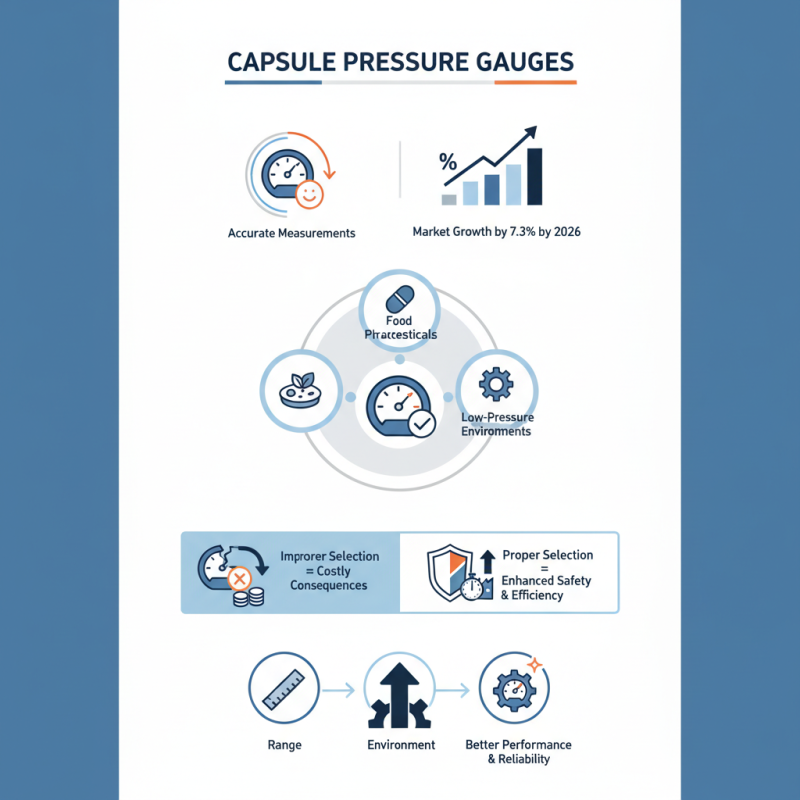
Selecting the appropriate Capsule Pressure Gauge is vital for accurate measurements in various applications. According to a recent market analysis, the pressure gauge industry is projected to grow at a CAGR of 7.3% by 2026. This growth highlights the increasing reliance on precise pressure measurement.
Capsule Pressure Gauges specifically excel in monitoring low-pressure environments. They are essential in industries like food processing and pharmaceuticals, where precise control is necessary. Quality and reliability are paramount; a significant percentage of gauge failures happen due to improper selection. Therefore, understanding your specific needs is crucial to avoid costly consequences.
Choosing the right gauge means considering factors like range, accuracy, and environment. With many options available, evaluating technical specifications can feel overwhelming. However, prioritizing these elements will not only enhance safety but also improve overall operational efficiency. Proper selection of a Capsule Pressure Gauge contributes directly to better performance and reliability in critical processes.
Understanding Capsule Pressure Gauges: An Overview
Capsule pressure gauges are vital tools for measuring pressure in various applications. Understanding their design and functionality can help you make informed decisions. These gauges are typically enclosed in a capsule, which deforms under pressure changes. This deformation translates to a readable output, usually in the form of a dial. Their simplicity and reliability are key advantages.
Tips for selecting the right gauge include assessing the pressure range needed. Ensure that the gauge can operate within your specific requirements. Accuracy is also crucial; even minor errors can lead to significant issues in sensitive applications. Additionally, consider the environmental conditions where the gauge will be used. High humidity or corrosive environments may require special materials to ensure longevity.
Remember to check the calibration before use. A poorly calibrated gauge might give misleading readings, causing potential hazards. It's wise to review user manuals and consult experts if you're uncertain about your choices. Engaging with professionals can provide insights that are often overlooked by novice users. By thoroughly researching, you can avoid costly mistakes.
How to Choose the Right Capsule Pressure Gauge for Your Needs?
| Feature | Description | Recommended Use | Approximate Price Range |
| Pressure Range | The measurable pressure range of the gauge. | Selecting gauges based on operating conditions, e.g., low or high pressure systems. | $50 - $300 |
| Accuracy | The precision of the gauge measurement, typically indicated as a percentage of full scale. | Standard industrial applications where accuracy is critical. | $100 - $500 |
| Material | Materials used in construction, such as stainless steel or plastic. | Corrosive environments that require durable materials. | $30 - $150 |
| Connection Type | Types of connections available, like threaded or flanged. | Specific installations based on piping systems. | $20 - $80 |
| Dial Size | The diameter of the gauge face. | Easy readability in various operating environments. | $10 - $100 |
Identifying Your Specific Measurement Requirements
When selecting a capsule pressure gauge, understanding your specific measurement requirements is crucial. The gauge's accuracy, range, and compatibility with your process media are essential factors. According to the American Society of Mechanical Engineers (ASME), pressure measurement inaccuracies can lead to costly mistakes. Therefore, precise specifications should guide your choice.
Consider the pressure range you will measure. A gauge with a range that closely matches your needs minimizes uncertainty. For example, if you commonly operate at 0-100 psi, a gauge that measures this range provides optimal performance. Industry reports indicate that pressure gauges deviating from the operational range often lead to inaccurate readings. This could affect your entire system's efficiency.
Additionally, think about the medium in which the gauge will operate. Corrosive substances might require specialized materials. Recent studies show that incompatible materials can degrade performance by up to 30%. This degradation can lead to system failures, resulting in downtime. By clearly identifying the conditions in which the gauge will be used, you safeguard against unnecessary risks. Your understanding of these elements can mean the difference between reliable operation and operational failure.
Factors to Consider When Selecting a Capsule Pressure Gauge
When selecting a capsule pressure gauge, several factors come into play. The measurement range is crucial. Ensure the gauge can handle the pressures you will encounter. A gauge with a range too narrow may lead to inaccurate readings or even damage. It's essential to know your operating conditions.
Accuracy is a critical factor. Check the gauge's specifications for accuracy ratings. Some gauges can drift over time, affecting reliability. Look for gauges that come with calibration certifications. These certifications can provide reassurance of the tool's precision.
Consider the environmental conditions, too. Will the gauge be exposed to moisture or extreme temperatures? Capsule pressure gauges have varying levels of durability. Some are designed for harsh environments, while others are more delicate. Finally, think about installation. Is it easy to integrate into your existing setup? A complex installation can lead to errors and increase downtime.
Evaluating Accuracy and Calibration Needs
When selecting a capsule pressure gauge, accuracy and calibration are critical factors to consider. A recent industry report found that 75% of pressure measurement errors stem from improper calibration. This highlights the importance of understanding how the gauge is calibrated and maintained. Accurate data ensures safety and efficiency in various applications, from industrial processes to medical devices.
Calibration requires regular checks against known standards. A gauge might lose up to 1% accuracy per year if not properly maintained. Periodically calibrating your equipment will help sustain its performance. This helps to identify any drift in readings before it impacts operations. Be aware that even high-quality gauges can show discrepancies during their lifespan.
Tips: Regular calibration every six months is advisable. Ensure that the calibration is done by a certified technician. Don’t overlook environmental factors either; extreme temperatures can affect gauge performance. Choose gauges that are easy to calibrate. Remember, investing in reliable equipment is essential for consistent results.
Comparing Different Brands and Models for Your Application
When selecting a capsule pressure gauge, consider the specific requirements of your application. Different environments may demand distinct pressure ranges, temperatures, and media compatibility. A model designed for corrosive substances may differ fundamentally from one used for clean air. When comparing, pay attention to the materials employed in the construction. This can greatly impact gauge durability and accuracy over time.
In addition to material, evaluate the accuracy and sensitivity of various models. Some gauges provide high precision at a specific pressure range, while others might be more versatile. It's crucial to assess how these characteristics align with your operational needs. You may find that a less expensive gauge performs adequately for your tasks. However, diving into user reviews and case studies helps identify any potential pitfalls.
Moreover, ensure that the gauge you choose can be calibrated easily. Calibration is vital for maintaining accuracy. If a gauge lacks straightforward calibration options, it may lead to errors over time. This situation can compromise not just efficiency but also safety in critical applications. Analyzing feedback from experienced users can provide valuable insights into performance and reliability. Balancing cost, accuracy, and usability is key to finding the right gauge for your needs.
