How to Choose the Right PCR Equipment for Your Laboratory Needs?
Selecting the right PCR equipment is crucial for any laboratory. The right tools can enhance productivity and accuracy. However, the options are vast, and the decision can be overwhelming.
When choosing PCR equipment, consider your specific needs. Different projects require different performance levels. A simple experiment may not need advanced models. Conversely, complex research demands high-precision machines to obtain reliable results. Check specifications carefully; not all machines are made equal.
Moreover, it's important to reflect on your budget. High-quality PCR equipment can be expensive, but investing wisely pays off. Evaluate the longevity and support offered. Sometimes, cheaper options can lead to frequent repairs, impacting productivity. Balancing quality and cost is essential for a thriving lab environment.
Understanding PCR Technology: Basics and Applications for Laboratories
Polymerase Chain Reaction (PCR) is a transformative technology widely used in laboratories. It amplifies small DNA samples, making them easier to analyze. Understanding how PCR works is crucial for any lab. The process involves denaturation, annealing, and extension. Each step requires precise temperature control.
PCR is not just for research; it has many applications. It’s vital in medical diagnostics, forensic science, and genetic research. Each application has unique requirements. For example, medical labs need high throughput and accuracy. Forensic labs often deal with degraded samples. A lab must consider its specific needs. Reflecting on these different contexts can help clarify equipment choices.
Choosing the right equipment can be tricky. Some may focus only on speed, neglecting reliability. Others might prioritize features, leading to overcomplication. Finding the right balance is key. Each piece of equipment comes with pros and cons. This decision needs careful thought and evaluation. Sometimes, labs make rushed decisions, which can lead to future issues.
Key Considerations for Selecting PCR Machines: Speed, Accuracy, and Capacity
When selecting PCR machines, speed is a crucial factor. Most laboratories prioritize quick results. However, faster machines may sacrifice accuracy. It's essential to strike a balance. Enhanced speed often leads to increased error rates. A machine that runs too quickly might not amplify DNA as expected. This could waste resources and time.
Accuracy is another vital consideration. High precision in temperature control is key. Variations can impact the amplification process significantly. A reliable PCR machine should maintain stable temperatures throughout the cycle. This stability ensures that results are consistent and reproducible. Inaccurate readings can lead to frustrated researchers and failed experiments.
Finally, the capacity of the machine can't be overlooked. Laboratories vary in size and output requirements. Some need machines that handle multiple samples at once. Others may require a compact model for smaller tasks. Assessing your laboratory's specific needs is essential. Purchasing the wrong capacity could limit productivity. Examine the trade-offs before making a decision. Reflect on past experiences to avoid repeating mistakes.
Essential Features of PCR Equipment: Thermal Cyclers and Real-Time PCR
When selecting PCR equipment, understanding essential features is crucial. Thermal cyclers are the core of PCR. They allow precise temperature control throughout the amplification process. Look for models with varying temperature ramp rates. This feature affects the speed of your runs. Fast ramp rates can save time but may compromise yield.
Real-time PCR equipment is another essential aspect. It provides real-time data on the amplification process. For experiments needing detailed quantification, invest in high-quality optics and sensitive detectors. The ease of use also matters. A user-friendly interface can make complex protocols simpler.
**Tips:** Always check compatibility with your lab's existing equipment. Request a demo to see if it meets your workflow needs. Take note of software support. It can significantly impact your data analysis. Make sure to consider future scalability too. Your current needs may evolve.
Comparison of Essential Features in PCR Equipment
Budgeting for PCR Equipment: Initial Costs vs. Long-Term Investments
When budgeting for PCR equipment, it's essential to consider initial costs versus long-term investments. Many laboratories allocate funds for cutting-edge machines. However, these purchases often come with high upfront costs. A recent report by the Global Market Insights indicated that the PCR market is expected to reach $11.4 billion by 2026. This growth signals the importance of investing wisely.
Initial costs may tempt you to opt for cheaper options. Yet, do these lower-cost machines deliver quality results consistently? Many facilities have faced reliability issues and higher maintenance expenses over time. This leads to increased operational costs. A study from BioTechniques highlighted that laboratories with older machines often see a 15% decline in efficiency. It’s crucial to weigh these factors.
Long-term investments can result in savings. Choosing reliable PCR equipment often translates to lower reagent consumption. Furthermore, enhanced accuracy can lead to fewer retests. The initial hefty prices can be offset with improved performance over time. Reflect on the long-term implications when selecting equipment. Spending less today might lead to larger costs tomorrow.
Maintenance and Support: Ensuring Optimal Performance of PCR Systems
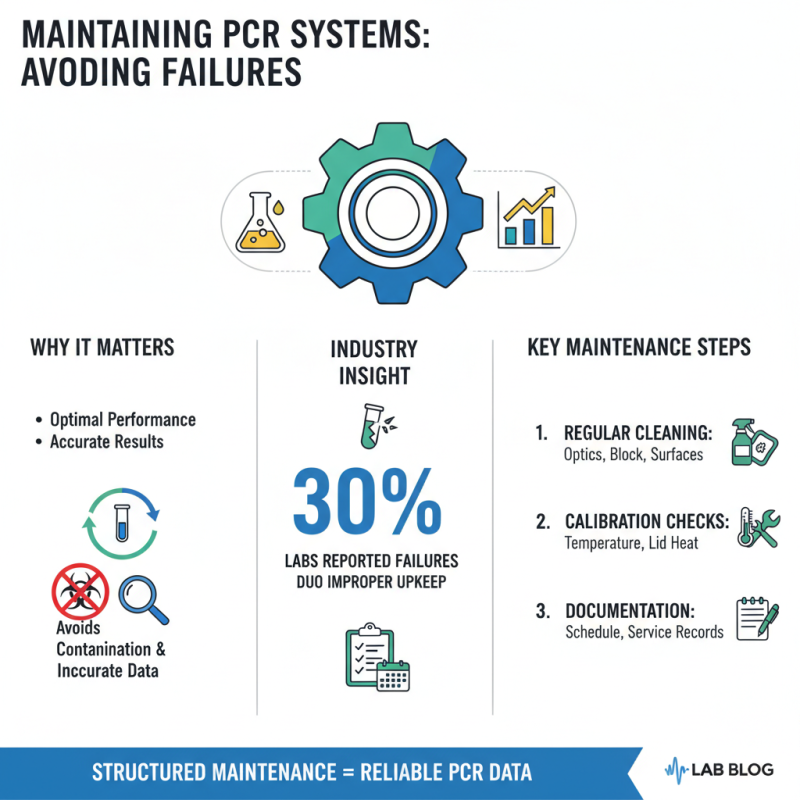
Maintaining PCR systems is crucial for ensuring their optimal performance. Regular maintenance helps avoid common issues, such as contamination or inaccurate results. A recent industry survey shows that 30% of laboratories reported failures due to improper upkeep. This emphasizes the need for a structured maintenance schedule.
Leaving PCR equipment unchecked can lead to costly downtimes. One key aspect of maintenance is calibration. Equipment should be calibrated every six months for accurate results. Neglecting this can lead to amplification errors, potentially affecting research outcomes. Additionally, a study indicated that 25% of users did not properly clean their machines. This can introduce variables that compromise PCR fidelity.
Support is equally important. Having access to technical support can often determine a lab's efficiency. Delays in response from support teams can prolong issues. Many labs, in fact, struggle with long turnaround times for troubleshooting. Investing in a reliable support plan may prove beneficial in the long run. It may lead to reduced errors and enhance data integrity, which is paramount in research settings.